Pratham Malviya

I am an aspiring AI Engineer with a passion for solving complex problems and building AI-driven solutions. For me, coding is not just a skillβ€”it’s a way to innovate, create, and transform ideas into reality. I enjoy tackling challenging projects that sharpen my analytical and creative skills and immerse me in the latest advancements in artificial intelligence and software development .

With a strong foundation in algorithms, data structures, and machine learning, I strive to develop intelligent solutions with real-world impact. My dedication to continuous learning, problem-solving, and growth drives me to evolve as a capable AI Engineer ready to take on complex technical challenges.

SKILLS

C++
Python
DSA
Deep Learning
Machine Learning
NLP
SQL

Education

Grade Xth (C.B.S.E.)

Kendriya Vidyalaya No. 1 School
Itarsi, Madhya Pradesh, India

Arpil 2018 - March 2019

In March 2019, I completed Grade 10 under the Central Board of Secondary Education (CBSE) curriculum, scoring 81.6%. I studied at Kendriya Vidyalaya No. 1, Ordnance Factory, Itarsi, where I maintained consistent academic performance across all subjects. During this time, I also got the opportunity to represent my school at the regional chess tournament, which helped me develop strategic thinking, focus, and discipline, while strengthening my foundation in core subjects and fostering a genuine interest in learning.

Grade XIIth Science (C.B.S.E.)

Kendriya Vidyalaya No. 1 School
Itarsi, Madhya Pradesh, India

April 2020 - March 2021

In 2021, I completed Class 12 (Science stream) under the Central Board of Secondary Education (CBSE) curriculum at Kendriya Vidyalaya No. 1, Ordnance Factory, Itarsi. I secured a score of 81% and studied Physics, Chemistry, and Mathematics (PCM) as my main subjects. During this time, I developed a strong foundation in analytical thinking, problem-solving, and scientific concepts, which helped me build a good understanding of core science subjects and prepared me for higher education in engineering.

B. Tech Computer Science & Engineering

Lovely Professional University
Jalandhar, Punjab, India

August 2021 - July 2025

I have completed my B.Tech in Computer Science & Engineering from Lovely Professional University, Jalandhar, with a Cumulative Grade Point Average (CGPA) of 7.29. The curriculum offered a comprehensive understanding of programming, algorithms, software development, data structures, and computer architecture. With a specialization in Machine Learning, I gained hands-on experience in designing and implementing models, working with datasets, and applying algorithms to real-world problems. This education not only strengthened my theoretical knowledge but also enhanced my practical skills, problem-solving abilities, and understanding of software engineering principles, providing a solid foundation for my future career in technology and research.

Portfolio
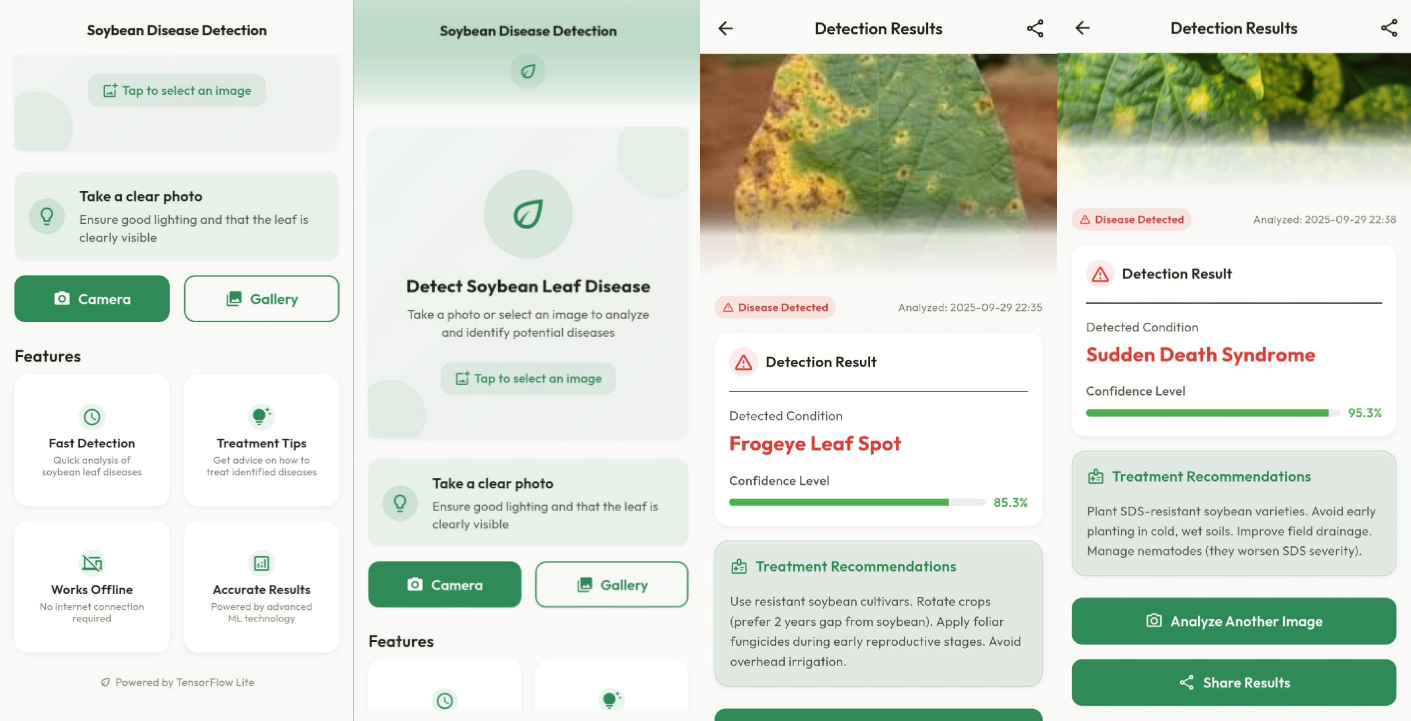
Soybean Leaf Disease Prediction

Soyabean Leaf Disease Prediction Project is a mobile app that runs on both Android and iOS devices. It is built using Flutter and Dart for the frontend, with the backend powered by CNN and Vanilla GAN. The model performs 7-class classification for soybean leaves using a dataset of 770 images (110 images per class). The app allows users to upload live images from the gallery to predict whether a soybean leaf is diseased or healthy. It also provides the confidence score of the prediction and recommends suitable treatments for the identified disease.

🌟 Disease Classification

The model is trained to identify the following soybean leaf conditions:

  • Disease 1: Bacterial Pustule – Causes small, raised spots on the leaf surface that may merge, leading to yellowing.
  • Disease 2: Frogeye Leaf Spot – Circular lesions with dark borders and gray centers, reducing photosynthesis capacity.
  • Disease 3: Rust – Orange to brown pustules on the underside of leaves, leading to early defoliation and yield loss.
  • Disease 4: Sudden Death Syndrome – Yellowing between veins followed by leaf drop, often linked to root infection.
  • Disease 5: Target Leaf Spot – Brown necrotic spots with concentric rings, resembling a "target-like" pattern.
  • Disease 6: Yellow Mosaic – Viral disease causing mosaic-like yellow and green patches, stunting plant growth.
  • Disease 7: Healthy – Properly classified as non-diseased leaves with no visible symptoms.

πŸ’‘ Future Plans

  • Dataset Expansion – Increasing the dataset with more diverse leaf images under different conditions.
  • Advanced GANs – Using DCGAN for generating synthetic leaf images to improve training accuracy.
  • Explainable AI – Adding heatmap visualizations (Grad-CAM) to highlight infected regions on leaves.
  • Offline Mode – Enabling disease predictions without requiring internet access.
  • Multilingual Support – Supporting regional languages for farmer-friendly usability.
  • IoT Integration – Connecting with drones/sensors for large-scale, real-time disease monitoring.
  • Improved Treatment Advisory – Expanding region-specific remedies, preventive care, and pesticide usage recommendations.

Made with ❀️ using Flutter, Dart, CNN & Vanilla GAN for accurate soybean leaf disease prediction.


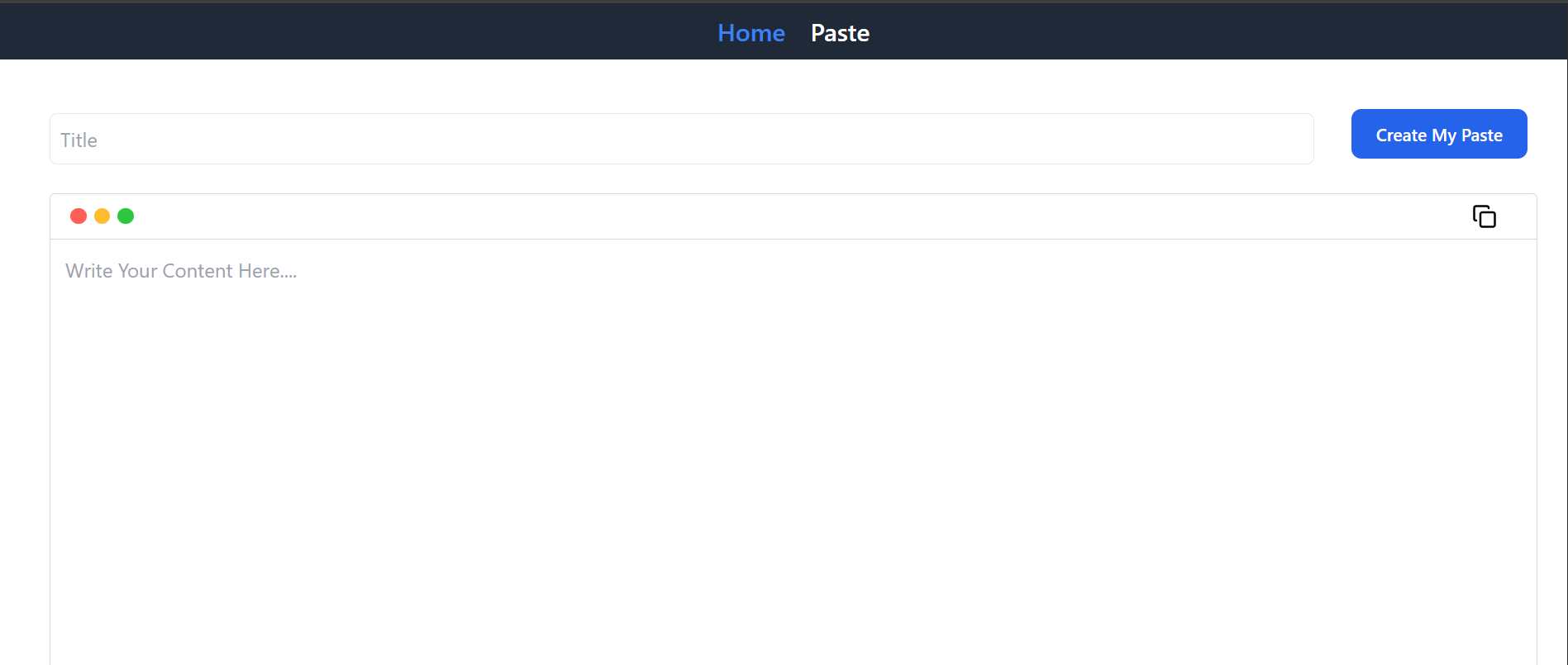
Clipboard Web Application

A self-learning full-stack clipboard platform built with React.js, Node.js, and Bootstrap that allows users to create, edit, search, copy, and manage text/code snippets, streamlining workflows and boosting productivity.

🌟 Overview

The Clipboard Web Application is a versatile platform designed to improve productivity by helping users efficiently organize and manage frequently accessed content. It provides seamless offline access and real-time synchronization across devices, ensuring smooth and reliable usage even in multi-user scenarios. The system combines a responsive frontend with a scalable backend to support continuous feature expansion.

πŸ”‘ Key Features

  • Create, edit, copy, and manage text/code snippets efficiently
  • Organize frequently accessed content across 10+ workflows
  • Boost productivity by reducing search time and streamlining knowledge sharing
  • Persistent storage using browser Local Storage for offline access
  • Responsive and modular UI with React.js and Bootstrap for smooth mobile and desktop usability
  • Supports multiple simultaneous users without latency

🧠 Implementation

Developed as a full-stack application with a React.js frontend and Node.js backend. Local storage ensures offline usability, while a modular UI enables easy future enhancements. The platform efficiently handles multiple workflows and provides seamless snippet management for users.

πŸ“ˆ Performance

Metric Result Notes
Productivity Improvement 75% Reduced time spent searching and improved knowledge sharing
Data Availability βœ“ Persistent storage via Local Storage for offline access
Multi-User Support βœ“ Handles simultaneous users without latency

πŸ“‚ Project Structure

  • frontend/ – React.js UI components and Bootstrap styling
  • backend/ – Node.js API endpoints and server logic
  • utils/ – Helper functions and offline caching

πŸ’‘ Future Plans

  • Enhanced snippet categorization and tagging system
  • Advanced search with AI-powered suggestions
  • Collaboration features for shared snippet libraries
  • Version control for snippet edits
  • Mobile app companion for on-the-go access

Made with ❀️ using React.js, Node.js, and Bootstrap for efficient snippet management and productivity enhancement.


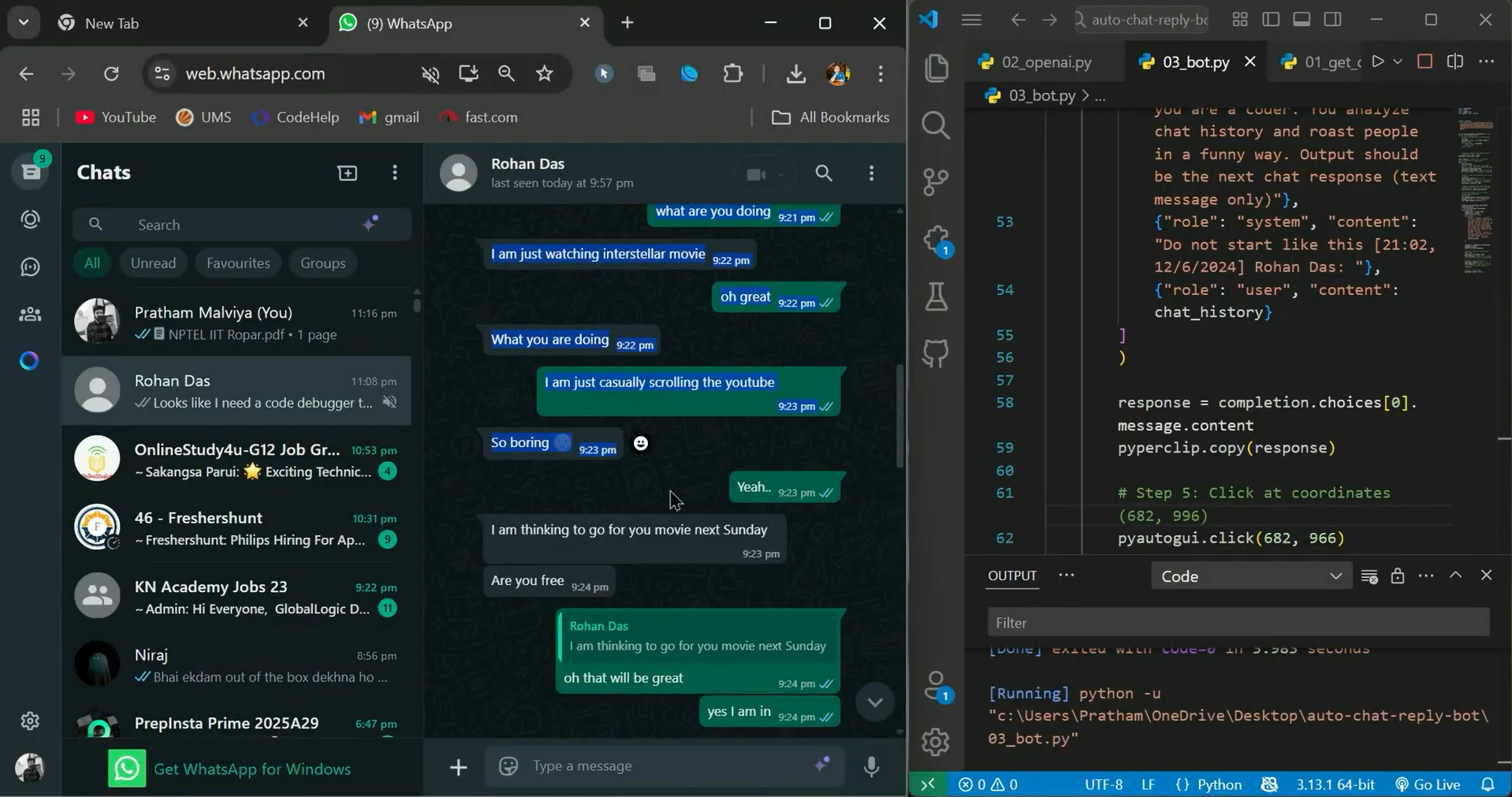
Auto AI Chatbot

A self-learning AI chatbot built with Python and OpenAI API that simulates human-like conversations, improves interaction reliability, and supports multi-platform deployment.

🌟 Overview

The Auto AI Chatbot is a context-aware, self-learning AI system designed to automate responses without manual intervention. It leverages OpenAI's ChatGPT API to generate human-like replies, enhancing user engagement and operational efficiency across web and mobile platforms. The chatbot continuously learns from conversations to improve accuracy, adaptability, and reliability in dynamic interaction flows.

πŸ”‘ Key Features

  • Context-aware responses with dynamic understanding of user inputs
  • Self-learning from interactions for continuous improvement
  • Optimized NLP pipeline for tokenization, embeddings, and caching
  • Multi-platform support for web and mobile deployment
  • Scalable and modular architecture enabling seamless external API integration
  • Automated handling of repetitive queries, improving support efficiency

🧠 Implementation

The chatbot is implemented in Python with a modular architecture that separates input processing, API inference, response generation, logging, and self-learning modules. It uses an optimized NLP pipeline to reduce latency and memory usage while maintaining high conversational accuracy and real-time performance.

πŸ“ˆ Performance

Metric Result Notes
Simulated Conversations 200+ Tested across web and mobile platforms
Reliability +25% Reduced fallback errors and improved response quality
Latency 40% reduction Optimized tokenization, embeddings, and caching
Memory Usage Minimal Efficient for resource-constrained systems

πŸ“‚ Project Structure

  • main.py – Entry point
  • chatbot/ – Core logic and NLP pipeline
  • services/ – API integrations and caching
  • data/ – Conversation logs and embeddings
  • utils/ – Helper functions and optimizations

πŸ’‘ Future Plans

Integrate advanced GAN-based response generation to create more human-like, contextually aware replies. Enhance adaptability across diverse user scenarios, improve conversational empathy, and expand multi-language support for global deployment.

Made with ❀️ using Python & OpenAI API for smarter, self-learning conversations.


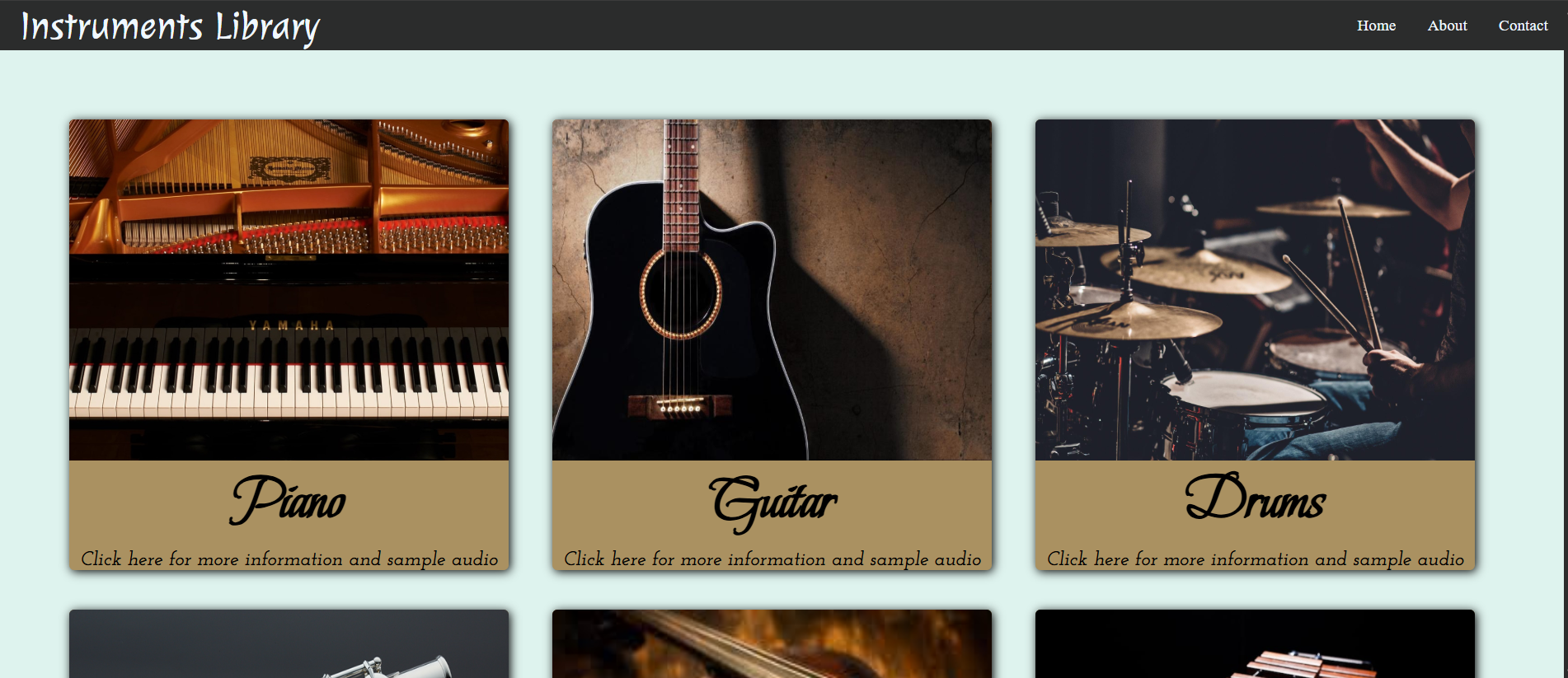
Website home page

Music Instruments Guide

An interactive web application showcasing 6 musical instruments: Guitar, Piano, Drums, Flute, Violin, and Marimba. Each instrument is clickable to listen to its sound and view detailed information. The app also includes two additional pages: "About" and "Contact". Developed as a collaborative team project.

🌟 Overview

This project provides a fun and educational platform for music enthusiasts. Users can explore instruments by clicking them, play audio samples, and read informative descriptions, offering an interactive way to learn about music.

πŸ”‘ Key Features

  • Clickable instruments: Guitar, Piano, Drums, Flute, Violin, Marimba 🎡
  • Play audio samples for each instrument directly
  • View detailed information about each instrument
  • Dedicated "About" and "Contact" pages πŸ“
  • Team collaboration enabled modular structure πŸ‘₯
  • Responsive design for seamless desktop and mobile experience πŸ“±πŸ’»

πŸ“ˆ Performance

  • Instant sound playback on click 🎢
  • Fast and smooth navigation between instrument pages
  • Optimized for both desktop and mobile responsiveness

πŸ’‘ Future Plans

  • Expand the list of instruments and include more audio samples 🎹πŸ₯
  • Add interactive quizzes and games for music learning 🧩
  • Introduce multi-language support for global users 🌐
  • Enhance accessibility for all learners β™Ώ

Made with ❀️ by Pratham Malviya & Niraj Kumar Sahu using HTML, CSS & JavaScript for an interactive musical learning experience.


Contact

Get In touch

Thank you for visiting my resume website! I am excited to connect with you and discuss potential opportunities. Please feel free to reach out by filling out the form below. Kindly provide your name, email address, and a brief message detailing how I can be of assistance.

My Address